Thredbo, Australia
Certified by EarthCheck
By Thredbo Resort, New South Wales
Located in Australia’s Snowy Mountains, Thredbo is Australia’s premier year-round alpine resort destination and voted Australia’s best ski resort for six years running at the World Ski Awards. Approximately 5.5 hours’ drive south-west of Sydney, this region of New South Wales is known for snow-sports, active lifestyles and wild, picturesque alpine scenery. Surrounded by the internationally recognised Kosciuszko National Park, Thredbo sits on Monero-Ngarigo traditional lands, populated by indigenous Australians for millennia, and is now home to an alpine village at 1,365m above sea-level and a mountain resort reaching to 2,037m in altitude.
Mt. Kosciuszko is Australia’s highest peak at 2,228m and is 6km north-west of the resort boundary. The National Park is a protected wilderness in Australia’s highest altitudes, housing delicate alpine ecosystems and unique fauna and flora. The significance of the Park and the landscapes in the high country cannot be overstated, and as such it is the responsibility of all who live, work, and play in Thredbo to contribute towards the protection of this fragile and special environment.
Thredbo as a destination was founded in 1955 by two European workers on the Snowy Hydroelectric scheme. Tony Sponar and Charles Anton had the vision of a European-style mountain resort where guests could stay and ski in similar style to those well-established resorts in the European Alps. In 1957 a rope-tow was installed for skiers, followed by a chairlift in 1958. Alongside this infrastructure came the construction of the Thredbo Alpine Hotel and private lodges, and Thredbo as we know it today was born. A lot has changed in the past 60-odd years, including expanding the area to 957 hectares and the creation of over 4,000 beds of accommodation. Thredbo as an alpine destination has consistently gained in popularity among Australian and international visitors.
Today, Thredbo is a 365-day operation providing snow-sports in winter, and mountain-biking and hiking in summer. To compliment these thrill-seeking activities, Thredbo now hosts music events, food and drink experiences, fishing, and relaxation and wellness retreats, so that anyone can share and enjoy our unique mountain setting.
Driving Sustainability
With the Kosciuszko National Park surrounding Thredbo we shoulder a responsibility to protect the local and wider environment. Over the last few decades a number of initiatives have been implemented in this space.
Primarily, EarthCheck has been our sustainable certification partner since 2014. Their destination standard and science-based methodologies have helped guide sustainability efforts in 14 key areas. Whilst this article is too short to delve into each one, more information on these areas can be sourced directly through EarthCheck. We are proud to have gained EarthCheck Gold certification for 2021 and 2022, with the aim to continue to improve performance into the future.
A key sustainability effort is the purchasing of 100% renewable electricity for Thredbo’s operations. Continuing our historic link with the Snowy Hydroelectric Scheme, we purchase electricity through their retail provider, Red Energy. As an industry that requires consistent snow fall, moving our electricity usage away from fossil fuels is important to us to help indicate that climate change is affecting the snow-sports industry and that there are ways and means to combat the hydrocarbon-based economy.
We are acutely aware that there are limits to the volume of our CO2 emissions which can be eliminated by practical means. For example, technologies are not yet widely accessible to power our snow grooming fleet solely on renewable energy, and at present there is very limited availability for fully electric buses for our village service. However, as new technologies enter the market we keep our finger on the pulse for anything that can help continue our leadership in sustainable resort management. The introduction of SNOWsat into our snow grooming machinery is one such example of technology improvement to help emission reductions. The highly-accurate GPS equipment measures the groomer positions relative to a pre-installed base map in order to report the depth of the snow in real time under the machinery. In turn, this feeds the data to the operator who can reduce the number of passes on a specific area, thus reducing fuel use, and lengthening the lifetime of serviceable parts.
In order to reduce waste-to-landfill, a 2023 target of 50% redirection of waste was established. Efforts to reduce wastage, improve recycling rates and redirect resources have led to a village-wide result of the avoidance of over 30% of waste being sent to landfill in 2022. To meet our target has proven to be challenging, but positive steps in on-site food organics composting have greatly helped reduce organic waste heading for landfill, thus preventing the generation of tonnes of methane emissions. Each year, further opportunities are found, ensuring our performance with regard to waste-to-landfill improves year-on-year.
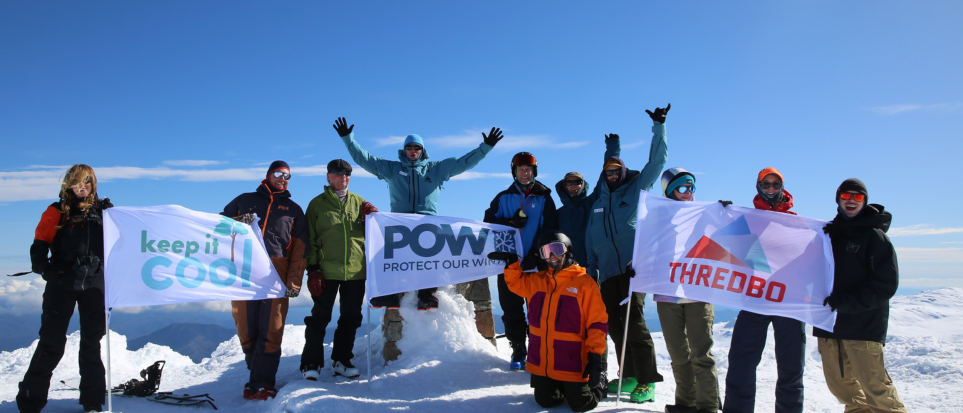
Direct support of the environment and ecosystems is a key pillar of Thredbo’s sustainability work. In this area we collaborate with Greenfleet to support native forest re-growth projects to help offset both internal and external fuel emissions. Guests are also provided direct access to join us in support of these projects across Australia. Locally, we partner with non-profit organisation Keep It Cool to re-introduce native forests on previously cleared pastoral land in the Snowy Mountains and Monaro region.
The Thredbo River supplies the village with water and Thredbo village is located at the very top of the wider Thredbo River and Snowy River watersheds. In order to be responsible first-users, we undertake all treatment of wastewater from Thredbo on-site and engage with the University of Canberra’s Applied Ecology department to measure river health through quarterly assessments. These efforts ensure that river fauna and flora, as well as human users further downstream, are protected.
Leave No Trace is an important aspect of the National Park user experience, and it is an aspect embrace by Thredbo’s outdoor product offerings. Our Guided Hikes and Backcountry Tours help visitors delve deeply, and safely, into the wild areas of the National Park outside the resort boundaries. Through showing guests the beauty and fragility of the alpine areas, whilst allowing enjoyment and providing education, it is intended that they too will become guardians of, and take a share of responsibility for, protecting the environment.
Looking Ahead
Planned upgrades to mountain and village infrastructure will support increased visitation whilst providing improvements in energy and water efficiency. Additionally, improvements in guest access to education on a number of topics will allow greater guest involvement in our sustainability initiatives; also benefitting performance improvements.
Practical work within Thredbo such as installation of free-to-use public electric vehicle chargers and retrofitting insulation to older structures are part of our strategy to improve Thredbo’s environmental sustainability. Behind the scenes, the continuation of our participation in EarthCheck’s certification process will allow us to find areas in which positive changes can be made.
It has never been more important for businesses to improve sustainability across all aspects, be it environmental, social, cultural, or economic. There’s no time like the present, and if we can use our present to make improvements for the future, then we will have succeeded in ensuring everyone can enjoy the unique mountain areas around Thredbo for many years to come.
Find more details on this topic at thredbo.com.au/about-thredbo/environment
This article was featured in the Destination Stewardship Yearbook 2021-2022, a collection of articles from the Destination Stewardship Reports. Co-produced by the Destination Stewardship Center, Center for Responsible Travel, and Global Sustainable Tourism Council.