The Inaugural Destination Stewardship Yearbook
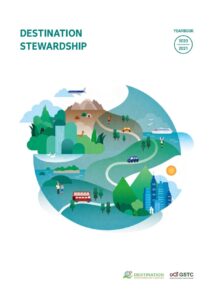
For those working to strengthen destination stewardship in a post-pandemic world, you may already be familiar with the e-quarterly Destination Stewardship Report, first launched in summer 2020. Now curated into a single, comprehensive resource, the Destination Stewardship Yearbook brings together highlights from the quarterly editions co-produced by the Destination Stewardship Center (DSC) and the Global Sustainable Tourism Council (GSTC), offering a consolidated collection of insights, case studies, and practical lessons for sustainable destination management.
What’s Inside
- Holistic destination management focus — Highlights a coordinated approach that considers not only businesses but also natural resources, cultural assets, community well-being, and infrastructure as part of sustainable tourism governance.
- Real destination experiences — Profiles of destinations embracing stewardship principles with collaboration among stakeholders and commitments to sustainability.
- Environmental & cultural revitalization — Case examples where destinations rejuvenated local environments and heritage by applying carrying capacity guidelines, integrating Indigenous knowledge, strengthening local leadership, and using assessment tools aligned with GSTC Criteria.
- Building back better post-COVID — Insights and guidance on recovery and resilience strategies for destinations navigating the early impacts of the pandemic.
- Learning from disruption — Reflections on how enforced disruption of travel created new baselines and opportunities to rethink how tourism interacts with host communities and ecosystems.
We began in the middle of a pandemic, an odd but telling time. The world was going through a forced experiment: What happens when tourism – especially international tourism – stops dead? A new baseline was being set, and with it came surprises. A second question, of course, can be phrased as “What’s the best way to recover as the pandemic begins to recede?” – a process still underway at this writing,” says Jonathan Tourtellot, CEO of Destination Stewardship Center and Editor of the Destination Stewardship Report. “As for the best way to recover, we’ve endeavored to profile places that already set good examples. We’ve addressed the critical importance of GSTC’s Destination Criterion A1 on holistic destination management – a fundamental yet frequently ignored requirement worldwide. We’ve offered profiles of places that are succeeding in our “Doing It Better” series, and places well on their way to success, as in the Italian Dolomites. We hope these models will, in whole or in part, help other places move toward more sustainable management of the intersection between tourism and host communities.”
“We invite all destination managers throughout the world to learn from these stories and encourage them to join the discussion by sharing with others what has worked – and even a bit of openness on what has not always worked so well,” says Randy Durband, GSTC CEO. “We hope you learn from, use, and share the knowledge provided. Here’s to ever-more sustainable tourism to destinations managed and cared for by committed stewards!”
The Destination Stewardship Report relies entirely on submitted articles. What experience, lesson, or innovation can you share that might inspire or guide others? We’d love to hear your story — reach out to us with your ideas!
About the Global Sustainable Tourism Council (GSTC)
The Global Sustainable Tourism Council® (GSTC) establishes and manages global standards for sustainable travel and tourism, known as the GSTC Standards. There are five sets: The GSTC Destination Standard for public policy-makers and destination managers, the GSTC Hotel Standard for hotels and accommodations, the GSTC Tour Operator Standard, the GSTC MICE Standard for Venues, Event Organizers, and Events & Exhibitions, and the GSTC Attraction Standard for tourist attractions such as theme parks, museums, and national parks. They are the result of a worldwide effort to develop a common language about sustainability in tourism.
The GSTC Standards form the foundation Accreditation for Certification Bodies that certify hotels/accommodations, tour operators/transport providers, and destinations as having sustainable policies and practices in place. GSTC does not directly certify any products or services; but provides an accreditation program to accredit Certification Bodies.
The GSTC is an independent and neutral organization, legally registered in the USA as a 501(c)3 non-profit organization that represents a diverse and global membership, including national and provincial governments, leading travel companies, hotels, tour operators, NGO’s, individuals and communities – all striving to achieve best practices in sustainable tourism. It is a virtual organization without a main office, with staff and volunteers working from all six populated continents. Financial support from donations, sponsorship, and membership fees allows us to provide services at low costs and to create, revise, and make available the GSTC Standards. The GSTC is an ISEAL Community Member, a global membership organization for ambitious, collaborative, and transparent sustainability systems; as well as an Association Member of The International Accreditation Forum (IAF) and an Associate Member with the InterAmerican Accreditation Cooperation (IAAC).
About the Destination Stewardship Center (DSC)
The Destination Stewardship Center (DSC) is a volunteer nonprofit organization dedicated to protecting the world’s distinctive places by supporting wisely managed tourism and enlightened destination stewardship. Founded as a program at the National Geographic Society, the DSC gathers and provides information on how tourism can help and not harm the natural, cultural, and social quality of destinations around the world. We seek to build a global community and knowledge network for advancing this goal.